

Of the over 5 million young students just in China affected by spinal issues like scoliosis, a significant number see these problems exacerbated by long hours spent studying at traditional, fixed-height desks that force their growing bodies into unhealthy postures. This silent crisis extends beyond spinal health, with poor posture also contributing to visual strain and reduced concentration. The fundamental flaw of conventional furniture is its passive nature; it fails to actively support a child’s physiological development. This is where the dual value of a modern children’s ergonomics desk comes into play. It serves not only as a tool for immediate scientific spine care by providing adjustable, tailored support but also as a powerful catalyst for long-term habit formation, instilling postural awareness that lasts a lifetime. At Contuo, we believe a child’s learning environment should be a proactive partner in their health, which is why our desks are engineered to offer this crucial dual-layer of protection and education, creating a foundation for a healthier, more focused future.
The Silent Crisis: Why Children's Spine Health Demands Attention

The statistics surrounding children’s spinal health are not just concerning; they signal a silent public health crisis. Recent data indicates that spine issues have become the third most significant threat to Chinese children’s health, with patients exceeding 5 million and approximately 300,000 new cases emerging annually. This is compounded by a child myopia rate surpassing 50%, a problem often exacerbated by poor postural habits that strain the neck and eyes. The issue is notably prevalent among adolescents aged 10-15, with girls being affected at a higher rate. The problem is growing at an alarming rate, with the number of affected children increasing by about 300,000 each year. This isn’t merely about posture; it’s about a child’s overall development. Untreated spinal problems can lead to visible issues like hunched backs and uneven shoulders, and also trigger more severe consequences, including impacts on cardiopulmonary function, reduced athletic ability, and chronic pain.
The root of this crisis is often a modern lifestyle of “prolonged sitting and insufficient exercise”. Children spend hours daily in a fixed position, often slumped over homework or hunched toward electronic screens. This static posture places immense strain on the developing spine. Traditional, fixed-height furniture is a major culprit, forcing a growing child’s body to conform to its rigid dimensions, which encourages slouching, tilting, and a cascade of associated health risks. The situation is further worsened by heavy backpacks and inadequate physical activity, creating a perfect storm for spinal issues to develop, often unnoticed until they become significant. The silent nature of this crisis demands immediate and informed attention from parents and educators alike.
The Science of Support: Ergonomic Designs That Actively Protect the Spine
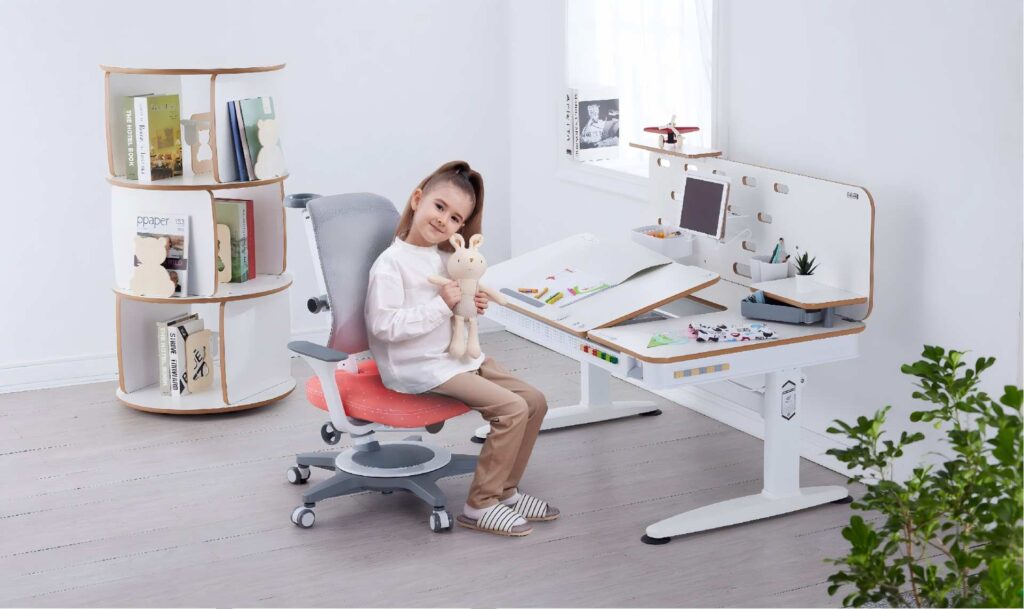
The core mission of a children’s ergonomics desk is to transcend passive furniture and become an active partner in spinal health. This is achieved through designs rooted in biomechanics and human physiology, which work in harmony with a child’s growing body. Unlike traditional, flat-edged desks that promote slouching, scientific support hinges on three key principles: dynamic adjustability, targeted zoning, and proactive guidance.
The most revolutionary feature is often the simplest: a curved front edge or “C-zone” design. This isn’t merely an aesthetic choice. A desk with a 7cm inward curve provides a dedicated space for the elbows to rest comfortably with support. This single design element reduces pressure on the shoulders and neck by approximately 25% by preventing them from hunching forward. It naturally encourages the spine to maintain its physiological S-curve, making the correct posture the most comfortable and natural option from the moment a child sits down.
Furthermore, dynamic height and angle adjustability are non-negotiable for a desk meant to last from childhood through adolescence. A high-quality ergonomic desk grows with the child, ensuring the desktop is always at the optimal height—typically where the forearms rest parallel to the floor with elbows at a 90-degree angle. More importantly, the tilt function is crucial for visual and spinal alignment. Scientific desks feature clear angle indicators (e.g., 0° for crafts, 12° for writing, 30° for reading, 40° for drawing) that allow for precise setup. This keeps the child’s head balanced and the cervical spine straight, as the book is brought to the eyes rather than the eyes straining down to the book, significantly reducing spinal load.
This support extends beyond the desk to the chair-desk ecosystem. A synchronized ergonomic chair with a wrap-around backrest and a saddle-shaped seat dynamically fits the spine’s natural curves, dispersing pressure and reducing fatigue during long study sessions. The ultimate goal is to create a unified system where the chair supports the lower back and promotes a healthy sitting posture (feet flat, knees at 90 degrees), while the desk supports the upper body, working together to maintain ideal spinal alignment.
Beyond Posture: How Smart Design Fosters Independent Habit Formation

While the immediate postural support of an ergonomic desk is vital, its most profound long-term value lies in its ability to subtly guide children toward independent, healthy habits. Advanced desk design transcends passive correction by applying principles of environmental design, where the workspace itself is engineered to make positive behaviors the most obvious and effortless choice. This transforms the dynamic from one of constant parental nagging to one of gentle, autonomous self-regulation. The desk ceases to be mere wood and metal and becomes an active partner in habit formation, leveraging cues, reduced friction, and positive reinforcement to instill lifelong routines.
A key mechanism is the strategic use of contextual cues embedded in the furniture. For instance, a bookstand positioned at the correct angle and a curved front edge that naturally supports the elbows serve as constant, non-verbal reminders to maintain a proper distance from the book and sit back in the chair. This eliminates the need for repeated verbal instructions, allowing the child’s environment to do the “nagging.” Over time, the physical setup of the desk becomes the trigger for a correct postural routine, seamlessly integrating into the child’s study habits without conscious effort. This approach aligns with the concept of habit-stacking, where the new behavior (sitting properly) is anchored to an established one (sitting down to study), making it more likely to stick.
Furthermore, smart design reduces friction associated with good habits. When the correct posture is also the most comfortable and supported position—thanks to features like angled desks that bring the work to the child and chairs that dynamically support the spine—the child is intrinsically motivated to maintain it. The desk effectively makes the healthy choice the easy choice. This fosters a sense of autonomy and competence, key drivers of intrinsic motivation, as the child experiences success and comfort from self-regulating their posture rather than from external correction. Features like height memory presets empower the child to take ownership of their ideal setup, further reinforcing this independence .
Choosing Wisely: A Practical Guide to Key Ergonomic Features
Selecting the right ergonomic desk for your child involves looking beyond aesthetics and focusing on features that deliver tangible health benefits. Begin by verifying the safety and stability of the construction. The materials should be non-toxic, with formaldehyde emission levels significantly lower than stringent international standards. Ensure the desk has a sturdy, wobble-free build, often achieved through robust T-leg or triangular support structures, to safely support a child’s active use.
The core of an ergonomic desk lies in its dynamic adjustability. Prioritize models that offer easy, tool-free adjustments for both height and desktop tilt. The ideal desk should grow with your child from kindergarten through high school, allowing the desktop height to be set so elbows rest at a 90-degree angle and feet sit flat on the floor. Look for clear visual angle indicators (e.g., 0°, 12°, 30°, 40°) for different tasks, which help maintain a proper viewing distance and prevent neck strain.
Finally, consider the ecosystem and certifications. A synchronized ergonomic chair with adaptive lumbar support is crucial for completing the healthy posture picture. Moreover, opting for products from brands that participate in setting or adhering to national ergonomic standards for children’s furniture is a reliable marker of research-backed quality, safety, and durability.
An Investment in a Healthier, More Focused Future

In summary, a high-quality children’s ergonomics desk offers a powerful dual return: it provides immediate, science-backed support for a child’s developing spine and eyes, while simultaneously fostering the intrinsic habit formation that underpins a lifetime of well-being . This transcends a simple furniture purchase; it is a strategic investment in a child’s capacity to learn with greater comfort and concentration, building a foundation where physical health and cognitive focus can thrive together. By making the correct posture the most natural and comfortable choice, these desks empower children to take ownership of their health, moving beyond reliance on constant parental reminders. The ultimate value lies not just in a straighter back today, but in nurturing a more confident, capable, and healthy individual tomorrow. We invite you to explore Contuo’s range of ergonomic solutions and make a lasting investment in your child’s future.

