
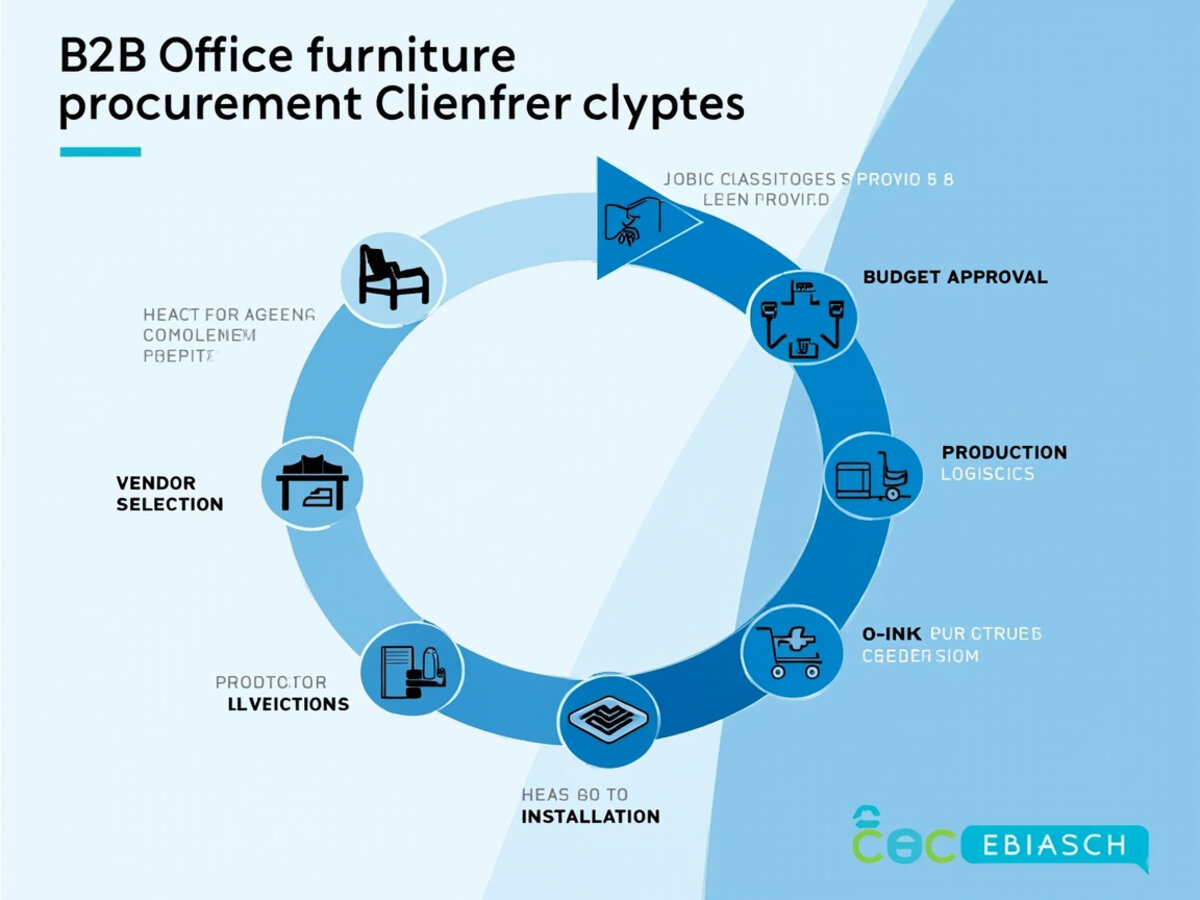
The B2B office furniture procurement process is rarely straightforward. Unlike a consumer purchasing a chair online, a company buying 50 height-adjustable standing desks for a new headquarters must navigate budget committees, compliance reviews, vendor vetting, and logistics coordination across multiple stakeholders. The entire cycle—from identifying the need to the moment desks arrive at the loading dock—typically spans 60 to 90 days for mid-sized enterprise orders.
Understanding this cycle is not merely an academic exercise. For B2B furniture suppliers, it means knowing exactly where to engage and what objections to preempt. For procurement managers, it means setting realistic timelines and avoiding the costly shortcuts that lead to receiving the wrong product six weeks later.
Stage 1: Need Identification and Internal Justification (Days 1–10)
Every procurement cycle begins with a problem or an opportunity. In corporate environments, the need for new office furniture typically originates from one of three triggers: a facilities manager noticing deteriorating equipment, an HR department implementing a new hybrid work policy, or an executive mandating an office redesign following a merger or expansion.
At this stage, the internal champion—often a facilities manager or office operations lead—must build a business case. This means quantifying the cost of inaction (declining productivity, rising sick days, employee complaints) and estimating the investment required. A mid-sized company replacing 50 standard desks with ergonomic standing desks should budget between $35,000 and $75,000 depending on specification levels.
The critical deliverable at this stage is a formal Capital Expenditure (CapEx) request submitted to the finance team. Without this document, no purchasing process can legally commence in most regulated industries.
Stage 2: Budget Approval and Procurement Authorization (Days 11–25)

Once the business case is submitted, it enters the approval funnel. In organizations with fewer than 200 employees, this may take three to five days. In larger enterprises with dedicated procurement committees, the review cycle can stretch to two weeks.
Budget approval involves multiple stakeholders: the CFO’s office validates the financial figures, the CHRO confirms the HR rationale, and the IT department assesses whether the new furniture integrates with existing cable management and monitor arm systems. For standing desks specifically, electrical compatibility (110V vs. 220V systems in global deployments) and load-bearing requirements for dual-monitor setups must be documented.
Procurement authorization typically requires a purchase order (PO) number before any vendor can be formally engaged. This PO becomes the binding document that governs payment terms, delivery timelines, and warranty obligations.
According to a 2024 survey by the Institute of Supply Management, 68% of enterprise procurement cycles experience delays at this stage due to competing budget priorities—a reality that procurement managers must anticipate and communicate to furniture suppliers upfront.
Stage 3: Vendor Research, RFP, and Selection (Days 26–45)

With a PO in hand, the procurement team begins vendor evaluation. For standing desk purchases exceeding $25,000, most enterprises issue a formal Request for Proposal (RFP). The RFP typically requires vendors to submit technical specifications, unit pricing, lead times, installation capabilities, and references from comparable deployments.
Evaluating standing desk vendors requires checking several non-negotiable criteria. Motor certifications (UL, CE, or BIFMA X5.5) confirm electrical safety. Frame load ratings must exceed the combined weight of desktop equipment plus the user. Warranty terms should cover at least five years for the motor and frame.
Lead time is often the decisive factor. Most Chinese manufacturers of electric standing desks require four to six weeks for production after sample approval. European and North American assembled alternatives typically offer faster delivery (two to three weeks) but at a 30–50% price premium.
A thorough vendor audit—including factory visits or third-party inspection reports—remains the gold standard for validating manufacturing quality. For orders exceeding $50,000, requesting a pre-shipment inspection (PSI) from a third-party QC firm such as Bureau Veritas or SGS is strongly recommended.
Stage 4: Order Confirmation and Production (Days 46–65)

After vendor selection, the purchase order is converted into a production order. The supplier confirms specifications, color codes, branding requirements (if applicable), and packaging instructions. A deposit—typically 30–50% of the total order value—is invoiced and must be paid before production commences.
For custom-configured standing desks (non-standard dimensions, proprietary color finishes, or logo imprinting), the specification approval process can add an additional five to seven days. Standard catalog configurations typically proceed directly to production scheduling.
During production, the buyer should request weekly status updates including production photographs and quality control checkpoints. Any deviations from agreed specifications discovered during production cost a fraction of what they would cost after delivery and installation.
Stage 5: Shipping, Customs, and Logistics (Days 66–80)

For international orders, the most complex phase begins as production finishes. The supplier coordinates freight forwarding—typically FOB (Free on Board) or CIF (Cost, Insurance, and Freight) terms depending on the contract.
Ocean freight from major Chinese ports (Shanghai, Shenzhen, Ningbo) to U.S. West Coast ports takes approximately 14–18 days. East Coast arrivals require 25–32 days via the Panama Canal. Combined with customs clearance (three to five days for routine entries) and inland transportation to the final destination, the total logistics window ranges from 21 to 40 days.
Buyers must prepare for landed cost calculations that include not only the product price and freight but also customs duties (Harmonized Tariff Code 9403.30.80 for wooden office furniture, or 9403.70.40 for metal-framed desks), broker fees, and last-mile delivery charges to the actual office location.
For European Union deliveries, REACH compliance (chemical safety regulation) and the new EU Deforestation Regulation (EUDR) requirements for wooden components add documentation burdens that must be addressed before shipment.
Stage 6: Installation, Inspection, and Payment (Days 81–90)

The final stage involves receiving, unpacking, inspecting, installing, and approving the furniture. Upon delivery, a minimum 48-hour inspection period is recommended before installation begins. This allows time to document any shipping damage and verify that the delivered products match the purchase order specifications.
Installation for 50 standing desks in a corporate office typically requires two to three technicians working two days. The supplier should provide installation guides, hardware kits, and remote technical support for any assembly challenges.
Final payment (the remaining 50–70% of the order value) is due upon completion of installation and sign-off by the facilities manager. For large deployments, retainage clauses—holding back 5–10% until a 30-day performance period passes—provide recourse for any post-installation defects.
Timeline Summary: The 90-Day B2B Office Furniture Cycle
|——-|———-|—————-|
Need IdentificationDays 1–10Business case, CapEx requestBudget ApprovalDays 11–25Finance review, PO issuanceVendor SelectionDays 26–45RFP, vendor audit, contract signingProductionDays 46–65Manufacturing, QC, pre-shipment inspectionLogisticsDays 66–80Freight, customs, last-mile deliveryInstallationDays 81–90Receiving, inspection, installation, sign-off
How Suppliers Can Accelerate the Cycle
Experienced B2B furniture suppliers recognize that procurement teams face pressure to compress timelines without sacrificing quality. Providing pre-filled RFP templates, offering stock inventory for rush orders, and maintaining transparent communication channels throughout the process can significantly shorten the effective cycle from 90 to 60 days.
Suppliers who proactively share production timelines, offer virtual factory tours, and provide detailed specification sheets reduce the vendor evaluation phase from 20 days to as few as 10. This competitive advantage—built on communication and transparency—is often more decisive than price in winning repeat enterprise orders.
For buyers, the message is equally clear: start the procurement process earlier than you think you need to. The desk you need today was ordered three months ago by someone who planned ahead.
References:
1. Institute of Supply Management. “2024 Procurement Survey Report.” https://www.ismworld.org/supply-management-news-and-reports/reports/annual-survey/
2. U.S. International Trade Commission. Harmonized Tariff Schedule, Chapter 94. https://hts.usitc.gov/
3. Bureau Veritas. Pre-Shipment Inspection Services. https://www.bureauveritas.com/
4. European Commission. EU Deforestation Regulation (EUDR) Guidelines. https://environment.ec.europa.eu/
5. BIFMA International. BIFMA X5.5 Performance Standards for Desks. https://www.bifma.org/